10 Years. 15,000+ Professionals. 130 Countries. Celebrate with 30% Off

close icon

Placing emphasis on SROI

If your answer is positive, then positively you belong among a vast majority of corporations that wish to plan strategies and suggest solutions, which truly cater for society’s needs, giving thus added value not only to society but also to the corporation themselves. As expected, the year 2013 made Social Return on Investment (SROI) stand out as key measurement tool for responsible companies operating locally or internationally, as it assists to understand, manage and communicate the social value that your work creates in a clear and consistent way with customers, beneficiaries and funders.

With the New Year 2014, quickly approaching and making crystal clear that SROI is here to stay, CSE being its basic scope to keep up with its groundbreaking actions in order to deliver correct and substantial information on Corporate and Social Responsibility issues, conducted with great success a Roundtable posing the next critical and begging question:

‘How can we measure the social effect of CSR strategies?

During the Roundtable emphasis was placed upon the challenges, which corporations confront regarding the investments in CSR actions and programs as well as upon the use of tools and international strategies like SROI, which could form the framework that measures Society coherent value.

Nikos Avlonas, CEO, stated: ‘With the existing economic climate, which is gradually recovering from recession, every contribution through corporate responsibility initiatives is of utmost importance not only for society but also for the survival of each and every corporation. Coherent value measurement of every social action managed with international standards will fundamentally contribute not only to  society, but also to the corporations themselves and Non- Profit Organizations, which will make their benefits more transparent.’

The most valuable component for the round table and CSR as a whole, was the willingness of CSR representatives from companies like Coca- Cola Hellas, Novartis and Mamidoil Jetoil S.A. wishing to showcase their own corporate best practices. Why? Because when you are doing the right thing for the right reason at the right time, you will undoubtedly want to shout it out loud!

Clearly the combination of companies promoting and reinforcing principles of corporate social responsibility, and the eagerness to discover how SROI is measured in order to enhance or alter their strategies, represents a massive step towards standardizing sustainable development.

Since CSE establishment in 2005, it has supported and realized groundbreaking actions regarding corporate responsibility and also planned strategies that reinforce innovation and responsible business both on a national and international level as well. For this very reason CSE new Advanced Certified Sustainability (CSR) Practitioner Training (IEMA Approved), to be launched for the very 1st time in Dubai 2014, March 10 & 11, includes a module on SROI, the latest CSR trends in the region and best practices.

Keen to join? Find out more here or simply contact Elisabeth Lincoln – Training & Marketing Coordinator (marketing@cse-net.org)

Tags

CSR

Did you Know that Companies with Certified CSR-Practitioners Increase their CSR Performance?

Here at CSE we recently conducted a research based on CSRhub to discover just how important CSR-Practitioners are in advancing companies’ sustainability journey. For those of you who aren’t aware CSRHub is a leading corporate social responsibility (CSR) and sustainability rating and information database. In order for CSRHub to produce sustainable and therefore actual results, their criteria looks into evaluating companies CSR efforts in 4 fundamental categories (Community, Employees, Environment, and Resources) and 12 additional subcategories. In turn the overall CSR rating score calculated by CSRHub creates a benchmark for companies to compare sustainability performance. So we are essentially referring to a benchmark for company performance, which establishes a broad, consistent rating with data from multiple sources derived by companies’ sustainability and CSR initiatives. To date, CSRhub rating methodology uses 257 sources to create a schema which reduces bias and among those sources, respectively, are six top leading ESG research firms and other diverse, credible sources.

So, in our research 8 companies with CSR-Practitioners served as the sample to investigate their overall CSR Ratings.

Our aim was to discover if there was any difference between companies CSR ratings before and after having CSR-Practitioners within their teams. In turn, the actions taken to compare the 8 companies CSR scores 1 year before and after CSE training, were compared to the corresponding industry average. Fast-forwarding, the data points were transformed into line graphs to illustrate the sustainability score trends. So the graph below “W.W. Grainger Inc”illustrates the data point 1 year before CSE’s training (B), compared to 1 year after the training (P1) and indicates the impact that the CSR-Practitioners 2 year action plan (from the training) may have had on the company’s overall CSR score. For a full picture of the Research and the 2 year Action plan that all our Certified CSR Practitioners conduct, please click here.


Image


Image

Overall, the results of the research indicate that improvement scores were found in the companies which had CSR-Ps.  Why? Simple!  All CSR-Ps have completed CSE’s Certified CSR training and upon completion they created a 2 year Sustainability (CSR) action plan for their company. The reason this is notable is, when implemented, the action plan introduces a carbon footprint strategy and energy reduction plan. This is a practical and measurable strategy which is under review for 4 month by CSE experts and is approved by a third party (IEMA- Institute of Environmental Management & Assessment) to ensure it meets standards and includes a variety of tools for approach. This action plan, implemented by the CSR-Practitionerss could have contributed to the improvement in overall CSR ratings.

Keen on having such an impact in your organization? Then join our upcoming Certified Sustainability & CSR Trainings approved by the Leading UK Institute of Environmental Management and Assessment (IEMA), in Europe, North America and the Middle East.

Certified Sustainability (CSR) Practitioner Trainings:

London, 17 &18 October 2013

Abu Dhabi, 24 & 25 November 2013

Houston, 7 & 8 November 2013

Atlanta, 14 & 14 November 2013

Certified Carbon Strategy Practitioner Trainings:

San Francisco 12 & 13 September

Atlanta, 19 & 20 September

Abu Dhabi, 27 & 28 November 2013

The practice of sustainability reporting is now embedded in businesses DNA, as it enables best practice in engaging with stakeholders, preparing to manage risk and measure sustainable economic growth in the long-term. So, if the question is whether your organization should invest in producing a sustainability report or not, the answer, in today’s vastly increasing demand for transparency, is that number speak for themselves! According to Marjella Alma, manager of external relations for the Global Reporting Initiative (GRI), 95 percent of the world’s 250 largest companies today disclose sustainability performance information. Why? Simply placed: “What gets measured gets managed”, which of course in turn enables you to gradually improve your performance whilst addressing the triple bottom line!  Now if the question within your organization is why publish a CSR report? Again simply placed, a CSR report acts as a vehicle to engage and communicate with stakeholders as it can ensure that a company is acting in a responsible manner! Yet to be credible, among many reasons, external assurance is vital for the integrity of data…No wonder 50 percent of companies internationally use external assurance for their reports!

 Consequently, a CSR report is of significant importance to organizations performance, but what in fact drives towards success? The two most important values are based upon the influences and motivations behind CSR as well as how decisions are made! For instance a resent research report conducted by Julia Bonner (New York University student) and Professor Adam Friedman on the influences and motivations of CSR in 77 Fortune 1000 companies, found that whilst CSR is more than often integrated within business strategies, thus doing the right thing, it is actually being done for the wrong reasons. According to the report’s results, environmental issues manifested the list as the most important focus for CSR efforts (96 percent), followed by health issues (68 percent), education (59 percent) and human rights (55 percent). Yet the reasons why the above pillars are addressed are motivated on reputation groundings by 88 percent of the respondents! On top of that, approximately two-thirds of these respondents stated that not engaging in CSR would have harmful effects on the company’s reputation.

Such motivations in turn indicate that CSR is not always altruistically driven, but the moral of the “story” is that if business motivations are built with such weak foundations and unsustainable principles, a collapse is bound to occur in the near future. Therefore before a company begins to engage in the philosophy of “What gets measured gets managed” and in turn produce a CSR report, it must embrace that acting in a responsible manner, needs to be done for the right reasons and represent the organization’s vision, mission and values holistically. There are many ways and guidelines on producing a sustainability report. To date the Global Reporting Initiative (GRI) is the world’s most widely used framework to effectively disclose environmental, social and governance data. Its guidelines aim to ensure Sustainability Reporting encloses valuable information about organizations material issues to stakeholders and it is currently used by more than 5,000 organizations worldwide.

Discover what it’s all about..here


On the 22-24 of May, CSE attended the Sustainability Leadership event of 2013, the Global Conference on sustainability and Reporting in Amsterdam! At the conference the new global guidelines for Sustainability Reporting, namely GRI G4 were launched followed by 1500 leaders and practitioners discussing key challenges and opportunities in making sustainability practical reality! Being at the G4 launch and having the opportunity to interact with the GRI managers and its interpretation for the new guidelines but also talking with other GRI Training partners from North America, Europe and Middle East we came into the following practical Q&A(s)  :

Positive Changes

Q(1): Why do companies need the G4?

A(1): Last year (2012) the GRI became the leading framework for global reporting for the majority of companies wishing to disclose annually their Sustainability performance. Consequently, a sustainability report should be a powerful stakeholder tool supporting companies to communicate their sustainability achievements visions, policies and achievements based on the structured global framework of GRI Guidelines.

As a result, disclosure based on GRI Reporting Guidelines is becoming a must for most organizations operating globally. Even Bloomberg has included GRI and External Assurance as one of the ESG Risk criteria whilst providing information to investors.  However the time and resources required gathering data and preparing a Sustainability Report is still a complex process for GRI users and many organizations are still pondering over the value they get from this process.

Q(2): Why are application levels replaced by core and comprehensive ‘’ in accordance’’ criteria?

A(2): Current application levels (A, B and C) have been replaced with ‘in accordance’ criteria for core or comprehensive GRI compliance. Frankly? it was time to solve this issue with the A, B, C application level confusion, hence, ‘In accordance’ criteria are more strict and you cannot use the terms partial or no compliance to any of required criteria in the GRI Index for core or comprehensive Sustainability Reporting any more. At the same time companies should disclose their performance in all or some  criteria if they consider them material related to its business.

Q(3): what are the impacts on companies about the change in disclosure on Management Approach (DMA)?

A(3):  G4 requires disclosure on Management Approach (DMA) information in any Category, Aspect or even Indicator level. Hence, companies should spend resources in Stakeholder Materiality Assessment based on the new DMA approach in order to disclose Sustainability data directly related to key impact areas related to its stakeholders. This may bring a reduction and flexibility in the Sustainability Reporting content but also a good understanding for all companies for its material related key impacts and being able to improve their sustainability Strategy

Q(4): is the G4  demanding more  governance and remuneration , Supply Chain and GHG emissions disclosure?

A(4): G4 requires more  disclosure around governance and remuneration, supply chain sustainability ,ethics and integrity, GHG emissions scope 1,2 and 3 . The impact on companies is that GRI’s greater attention on responsibility in all above mentioned issues could be a useful wake-up call for Boards of Directors and Company Executives. Additionally the inclusion of all these topics in the Sustainability Report  will probably  facilitate better sustainability integration top down to reporting companies and may force some to include all the new  ‘’hot sustainability topics’’ in their business  strategy.

Q(5). Is more in depth External Assurance suggested for the G4?

Indeed, the G4 pushes organizations to consider more the importance of external assurance than the G3.1.Although G4 does not require external assurance as its previous version G3.1, it appears that there is more emphasis for detailed external assurance for all criteria covered by GRI. Nonetheless, at the end of the Report in the GRI Index a table should indicate all areas got external assurance by a third party organization.GRI still remains flexible to external assurance, however, it requires more in depth assurance for all companies deciding to do so.

It is important to be mentioned that GRI has not decided yet if they will continue providing a third party assessment check to all guideline users.

Regarding the gaps of GRI guidelines our conclusions suggest that:

1. The G4 seems to still be non user friendly and complex for Sustainability Reporting beginners. Thus, GRI should create a simplified version of the guidelines for those want to move on into Sustainability Reporting

2. G4 does not provide more detailed information or refer to widely used guidelines for external assurance like AA1000 and other guidelines. Therefore, even if the original objectives of G4 were to make it more compatible with other guidelines  there is no specific guidance or reference to other Standards as it should be.

3. G4 terminology is still complex and different professionals may have different interpretation of criteria and approach. We most certainly feel that GRI should provide a Q & A guide for all Sustainability Professionals in order to avoid confusion to its audience

Conclusions

Nonetheless, we would like to emphasize that the G4 is a great opportunity for companies to rethink reporting processes and how to integrate Sustainability within their business Strategy. In the upcoming months you will undoubtedly hear many different interpretations of the G4 guidelines; however, it does seem that the G4 can be a way forward for Sustainability Reporting with new criteria including accountability, supply chain management and ethics in a more flexible manner regarding key impact areas in meeting stakeholder expectations, but it requires more detailed disclosure in all criteria.

If you would like to be one of the first to  learn more about the developments and the practical application of the G4 Framework and its impact to your business , join CSE round table held in Dubai after the Certified Sustainability (CSR) Practitioner Training on the 19-20 of June, or in New York also to be delivered after the Certified Sustainability (CSR) Practitioner Training, 13-14 of June

Tags

CSR

Avoid Blacking the Green

Have you ever wondered what the sentence “green is the new black” actually means? Well as black is a color reputed to match almost everything, so does green in today’s business arena, as is a color that no successful business can afford to not “wear”.. as long as you do not wear and tear! Companies being or turning green essentially refers to their internal strategies integrating sustainability principles, and thus, acting responsibly by contributing towards a sustainable development for our common good! This of course has been a result of the awareness raised about the impacts anthropogenic actions are having on our ecosystem accompanied with the just how much corporations are contributing to the “CO2 pie” (emissions). Now, it should come as no surprise that within this equation corporations own up to a large part of the CO2 pie but it should also come as no surprise that corporations simultaneously have the power to make their part of the pie more sustainable in the long run for society and the environment, whilst reaping the benefits of being a good corporate citizen.

Consequently, by taking a peek into how businesses today are communicating to their stakeholders you will quickly come to find that they are falling all over themselves to deliver the message that they are environmentally and ecologically conscious and correct!  At present, some businesses are genuinely committed to making the world a better a place to live in, and hence more sustainable, but yet far too many are portraying sustainability efforts as a method of attracting potential customers, as environmentally conscious consumers are expanding tremendously ! This essentially done through corporations trying to pass off as eco-friendly, when what they are in fact doing is hiding behind their not so green footprints! Consider for instance putting an image of a forest on a bottle containing harmful chemicals. Other corporations pass off eco friendly behavior to their stakeholders through exaggerating the truth about the the percentages of their products being beneficial to the environment. Such actions at best has brought a wave of confession to consumers as to which products they can truly trust, and at worst has created the notion of green washing being a major contradiction to the expansion of sustainable development.  This of course is not to say that when making an effort towards being more sustainable marketing the action is forbidden, but more acknowledging that true results are found in walking the talk opposed to talking the talk.  Besides, in today’s society’s fast growing awareness and interest in Sustainability and Corporate Social Responsibility married with the expansion of organizations alike corporate watch dog, and  Stop Green Wash which in turn keep a close eye on organizations green washing, it would be ludicrous for businesses to not wake up to the economic benefits of environmentally sustainable practices and products.

CSE, being a leader in the CSR field since 2004 and having trained more than 5,000 individuals across North America, Europe, Asia, Africa, and the Middle East are implementing the most advanced methodologies for professionals across sectors and industries on Corporate Social Responsibility and Sustainability – strategy, reporting, management and communication. If you are interested in avoiding green washing and investing in the business case of CSR , join our upcoming Certified Sustainability (CSR) Practitioner Trainings delivered worldwide!

Tags

CSR

It is widely known that Corporate Social Responsibility (CSR) is the way that leading companies nowadays do business, not only because it is clearly the right thing to do, but also because it is accompanied with long term benefits. One of the benefits CSR is reputable for is its ability to enchase, if not build, your business’s image and reputation. On this note it is important to emphasis the difference between image and reputation! A business’s reputation is something that is build and developed throughout its establishment, essentially how a company is perceived by its stakeholder. On the other hand a company’s image refers more so to how you want to emerge to your existing and potential customers. More specifically, Bloomberg Business Week states “it’s what you want to convey about yourself, your business, your product, your work ethic, and your professionalism combined with the strategy you’ve developed to reach your target audience”. Consequently, a company’s image is also very important to its success but can be altered in a more flexible manner in comparison to its reputation! Consequently, having and sustaining a good reputation is an absolutely fundamental asset for businesses success, due to the fact that a great part of consumers’ decision making is placed on image and reputation. Consider for instance, the damage done to Nike’s reputation from using child labor in the 90s! So, the lullaby of “sticks and stones might break your bones but words will never hurt me”, does not always apply in the business arena, word of mouth will hurt you!

So how are companies utilizing CSR towards their brand image and reputation? Well, by browsing through how companies are communicating to their stakeholders today, you will quickly find that the triple bottom line of Sustainability is transpired in the way brands are communicating and consequently how they want to be by perceived! An international taste of what is going on can be seen through Coca-Cola wishing to contribute positively towards the obesity issue taking place in the United States, as just last week  Coca-Cola launched its new anti-obesity campaign. The campaign draws attention to their drink choices having low calories and made with natural sweeteners, in order to get young people active and take obesity seriously. Now, this might seem to some a “common sense” fact, but nonetheless the heart of the campaign is dedicated to help minimize obesity, hence society. The Hershey Company on the other hand, well aware of the calories captured in chocolate and knowing there is nothing you can do but indulge, came up with a different way of contributing positively to society, the company stated to source 100 percent certified cocoa for its global chocolate product lines by 2020, and help eliminate child labor in the cocoa regions of West Africa. On a greener note, P&G (Procter & Gamble) launched a campaign last week to inform its vast amount of stakeholders that they are doing their bit for the environment as they continue to give preference to Forest Stewardship Council (FSC) certification, and aims to reach at least 40 per cent of the pulp used in P&G’s tissue-towel products to be FSC-certified. Marks & Spencer’s is also a good example, in 2007 it announced wanting to become the world’s most sustainable major retailer, and since then its business strategy changed to Plan A. So far, their efforts are doing tremendously well, and rank 238 in the Global 500 for 2013.

The above examples are just a small sample of how businesses are communicating their brands today and the image they wish to portray of themselves towards their stakeholders! With Walmart announcing this week that it aims by 2017, to buy 70 percent of the goods it sells in U.S. stores only from suppliers using the Sustainability Index, undoubtedly we will witness an increase in CSR as companies will need to stay in the league with their competitors as well as sustain their corporate image!

Have you intergraded Sustainability into you business strategy yet?

Tags

CSR

According to the most recent GreenBiz State of Green Business report, an increasing number of environmental performance results will be both reported and explained in the form of an Integrated Report (IR). An IR accounts for the inclusion of absolute environmental costs, which are “tallied by compiling companies’ individual impacts, such as carbon emissions, water consumption and waste, and assigning a cost to each impact.” Very few companies have yet to factor these considerations into their accounting systems, let alone report such information to investors. But GreenBiz notes that as governments begin to regulate carbon and as the climate change causes shifts in the monetary value of resources companies rely on, environmental costs will become a bigger lever for success or failure.

When it comes to addressing environmental costs, the areas of requiring the most attention occur outside the corporate office, in sectors such as operations, facilities, fleets, energy and real estate. The buildings sector is one part of the climate change equation with the greatest potential for significantly reducing greenhouse gas emissions and addressing environmental costs. The United Nations Environment Programme (UNEP) estimates that buildings are responsible for more than 40% of energy use internationally, one-third of greenhouse gas emissions and 30% of raw material use. “Greening” corporate real estate can help achieve deep cuts in greenhouse gas emissions both rapidly and cost-effectively, while simultaneously allowing companies to better manage and measure their environmental performance.

The recent trend of integrative reporting is already accounting for this component by urging companies to provide a basis for identifying and quantifying the projected benefits from investments in green building, and by fueling interest in integrating building sector reporting standards under the GRI and other frameworks.

Given investor and consumer consciousness of labeling programs, it is no surprise that as sustainability reporting develops to include these factors, many companies also seek certification to better communicate their green building initiatives. Studies show that because of investor and consumer awareness, certified buildings often lead in business activity; for instance, PNC Financial Services Group’s LEED rated facilities opened more than four hundred additional consumer deposit accounts and had more than three million more in consumer deposit balances per facility per year than non-certified properties. Overall, certifying a facility can exponentially improve a company’s financial performance and help to lower its operational costs.

Yet, the green building certification process remains a huge barrier for many businesses seeking to incorporate green building in their sustainability strategies. Programs such as LEED (Leadership in Energy and Environmental Design) can add millions to construction costs while promising to cut other expenses. The additional costs of hefty certification fees and the soft costs of consultants and other hires leave little room in the budget for improving a buildings’ sustainability performance post-certification. And because corporations sometimes require various property types (whether owned or leased) to operate their business, there may exist drastically different conditions for each building seeking certification. Frustration over costs, building limitations and impracticalities of requirements consequently causes some businesses to throw their facilities to the wayside with certification.

But if the operation and management of corporate real estate plays a significant negative or positive factor in a company’s social responsibility, citizenship, or sustainability actions, then this shouldn’t be the case. Some may find that they can no longer afford to ignore the certification procedure – through certification they can more effectively address the critical role of their real estate assets.

One way that CSE is helping companies to achieve this in a less costly manner is through SERF, or the Society of Environmentally Responsible Facilities. SERF was designed in an effort to avoid many of the issues encountered with green building certification – mainly that it can be cost-prohibitive, timely, and oftentimes inaccessible. With SERF, integrity no longer trumps applicability – users avoid settling for a single trophy building by applying one rating system along an entire building portfolio at a much lower cost.

SERF offers an approachable method for certifying all facility types, whether that is a leased office or a warehouse, a small urban building or a large rural one. The process itself saves time and money by moving away from reliance on third-party consultants and commissioning agents for documentation (although all SERF documentation is verified by a licensed architect or engineer before certification is granted). Better yet, it’s flexible. Users can better address their sustainability goals by choosing to certify a building through a prescriptive pathway or a performance-based pathway. A dynamic scoring system also offers criteria that are considerate of building environment and limitations. The result? There’s no need to beat your head against the wall to achieve simple, streamlined results – you can have your green building and flaunt it too.

Sustainability is about longevity, but it is also about transformation. “How do we respond to challenges and evolve for the better”, is always a question central to any leadership strategy. But being able to effectively communicate that question, connect it to a larger movement, inspire higher performance, find innovative solutions and influence traditional thinking are all characteristics that pertain to only a certain kind of leader. Given the recent flurry of climate change scares, there is no doubt that it is this concept of a “transformative leader” that will be leading the year’s discussion.

What is transformative leadership? Simply put, transformative leaders focus on their followers: they motivate followers to achieve higher levels of performance, listen and respond to their needs, challenge them to be innovative and creative, and in the process help them to develop their own leadership potential.

A recent report by The Climate Group spells out five traits that need to be embraced by business and government in order to create transformative leaders and achieve long-lasting, low-carbon results. The first step? Embrace change.

Many political and business leaders already acknowledge change, but only in recent years have we seen these leaders begin to embrace change as an instrumental part of longevity.  For instance, in his second Inaugural Address, President Obama announced a renewed commitment to clean energy and greenhouse gas reduction. In doing so he warned America of the need to change with changing times: “The path towards sustainable energy sources will be long and sometimes difficult. But America cannot resist this transition; we must lead it.” World Bank President Kim Jong Kim has also recently promised to make tackling climate change a top priority during his term. These leaders are beginning to embrace carbon reduction – not as a goal, but as a long-term and integral strategy for profitability, economic growth, and security. Their brute regulation is not only imminent, but also reflective of a new style of leadership: one that is strategic, determined, and receptive to the possibilities of change.

With decisive leadership also comes disruptive leadership. Transformative leaders create controversial strategies that challenge the way sectors and state interact. According to Senate climate guru Barbara Boxer, we can expect to see this approach in upcoming U.S. policy, whether in the form of a revenue-generating carbon tax or re-energized EPA regulatory schemes aiming to drive businesses to compete in energy markets and pave the path for clean energy.

We’ll also witness this as an increasingly common business strategy for success. According to The Carbon Disclosure Project, more than two-thirds of business already put climate change at the heart of their business strategies. Most of these companies are reporting their emissions at the company level. However, many more are challenging the status quo by learning how to extend emission reporting from the confines of their own operations to the wider effects of their products – re-defining the scope of reporting to include categories such as product use phase, end of life phase, and carbon abatement of products and services.

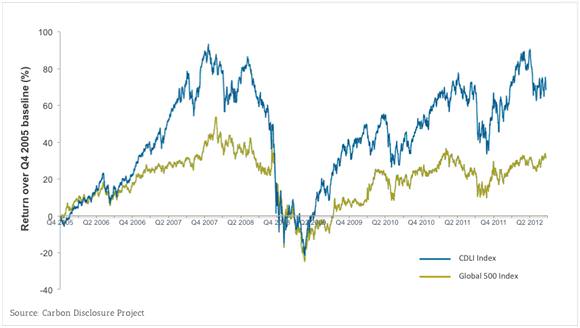
The business Case is evident in the following graph where  organizations that join the Carbon Disclosure Leadership Index (CDLI) have much better financial performance overtime that all the others in the Global 500 Index. The  CDLI includes Siemens, Coca-Cola, Microsoft and many other industry leaders


At the Centre for Sustainability & Excellence, we observe these progressing trends with a growing number of professionals attending our global Sustainability and Carbon Strategy Practitioner training programs in all major cities including NY, Chicago, San Francisco, Atlanta, Toronto, Tokyo ,Dubai and Brussels  . Our registrants hail from forward-thinking companies like United Airlines, Walmart, Unilever and ABM. Their backgrounds are diverse – comprised of Sustainability and CSR Officers, Communications and Marketing Directors, Investor Relations and even Media Relations departments. What unites these individuals is a growing demand to learn: how to be radical, how to be transformative, and how to create impactful, enduring value.  Our upcoming training held in Chicago on March 7-8 is was designed in response to this maturing mentality; the training includes all scopes of GHG emission reporting, as well as incorporates hot topics such as water footprint, Life Cycle Analysis, and carbon reduction via green building.  As many more begin to follow these trends and pursue such knowledge, simple policies and reporting will no longer be enough. Investors and stakeholders alike will be looking for radical strategies that aim to create long-lasting impact – those professionals without the right amount of know-how might as well fold their cards to this new era of transformative leadership.

2012 introduced several significant developments in sustainability, most notably around the issues of climate change, risk management, and supply chain ethics.

June’s Rio+20 United Nations Conference for Sustainable Development dominated the year’s discussion, reinforcing the need for corporations to play a larger role in attaining sustainable development goals. PricewaterhouseCoopers’ Low Carbon Economy Index publication supports this sentiment, showing only minor improvements in global carbon intensity reduction. As climate change regulation escalates in response to these numbers, we can expect to see more investors and consumers paying attention to corporate sustainable development strategies.

Companies anticipate these changes. More than two-thirds of Fortune 500 companies now issue sustainability reports, with many also investing in sophisticated methods of tracking and reporting emission data. The Carbon Disclosure Project reports that in 2012 alone top firms integrating climate change into their business strategies reduced their emissions by nearly 14%. In 2013 we can expect to see even stronger corporate leadership in sustainable development as more corporations begin to report their carbon and water footprints, use methods of assurance to confirm data, and develop long-term carbon management strategies throughout the supply chain.

Social and environmental risk management will also be at the forefront of 2013. 2012 was filled with corporate behavior scandals. Companies like Barclays and Walmart found themselves in the spotlight amid global concern over lack of corporate and supply chain ethics. Superstorm Sandy and other natural disasters raised further questions about the ability of companies to adapt and become resilient to social and environmental challenges. Greater investment in supply chain management, stakeholder engagement and financial-environmental reporting will develop as business leaders seek to address these reputation and environmental risks. Expect one popular management strategy – “social license to operate” to lead the year’s discourse.

As sustainability become more mainstream, one trend also continues to hold promise: companies will continue to expand their investments in sustainability, and intensify their focus on pressing issues like energy efficiency, natural resource management, and health & safety. A study by the Massachusetts Institute of Technology shows that greater numbers of companies view corporate environmental and social responsibility as a profit boost. 2013 will see increased corporate spending on sustainability issues like clean technology, sustainability reporting assurance, and corporate sustainability programs. In 2012 this was already made evident with evermore additions of chief sustainability officers to corporate boards; Unilever was one among many to expand its sustainability teams. 2013 will continue this trend with individuals being recruited internally from supply chain management, communications, marketing, and other units, to develop sustainability initiatives.

Sustainability (CSR) directives will become more coordinated across departments, causing a big shift in corporate structure and thinking. Corporate heads will look to leaders that can demonstrate the drive and flexibility needed to collaborate across business units and influence decision makers. Sustainability and CSR officers will adopt different roles in marketing, communications, management or project coordination. A recent article by Ethical Corporation argues that renewed emphasis on strategic planning will bring about more pragmatic programs and effective communication of the value of sustainability throughout company sectors. In short, these efforts 2013 will invoke a much broader understanding of sustainability, with greater opportunities for collaboration internally.

Externally, we will also begin to see a shift in thinking, as corporate marketers, communication managers, and sustainability directors direct their attention to consumer behavior. Stricter carbon regulations will encourage companies to identify more effective methods of consumer engagement Additionally companies they will also understand that Sustainability Reporting in not enough and that they need  further stakeholder engagement with their employees, community and investors for increase stakeholder value

Corporate social responsibility (CSR) is a concept that has been defined differently and falls under many umbrellas, yet its concept to an extent remain the same world, being that corporations can no longer grow economically if their growth is not shared with society. This in other words means that businesses accountability has shifted away from the singular of shareholders and investors to a wider picture bringing in a wide range of stakeholders. Therefore businesses responsibilities have shifted away from simply making profits and moved towards making sure that any profits made address environmental protection, the wellbeing of employees, the community and civil society as a whole, both now and in the future.

Throughout the years there have been many drivers pushing forward CSR and expanding the urgency worldwide. To date the most important drivers of CSR have been:

1. Demands for disclosure

Stakeholders nowadays, being customers, suppliers, employees, communities, investors, and NGO’s demand for corporate disclosure!

2. The ever changing role of governments

In the past, governments have relied on legislation and regulation to deliver social and environmental objectives in the business sector. Governments have been puzzled with how to tackle CSR and generally if it an area that they can indeed influence, thus, this confusion has led to the discovery of voluntary and non-regulatory initiatives instead.

3. Increase in ethical consumption

Countless of surveys prove everyday that ethical consumption is on the raise, showing how more and more conscious consumers are either rewarding or punishing companies based on their Corporate Social performance.

4. Rising investor pressure

Investors are changing the way they assess companies’ performance, and are making decisions based on criteria that include ethical concerns as investors reputation is at stake also if it invests in companies who do not consider the triple bottom line in their decision making!

5. Retaining and attracting employees

In today’s business market, employees not only place importance upon their paycheck but also upon the company’s philosophies and principles, in order to find a perfect match!  This shift in employee principles has brought as a result to improve working conditions.

6. Supply chain

Nowadays suppliers expect business to be corporately responsible and take into consideration among others issues related to labor practices, working conditions, fair payment across the supply chain and through the life cycle of the product/service. In order to protect the quality of services as well as reputation, suppliers and businesses as a first step, have moved into developing and complying codes of conduct.

Positively, the concept of CSR has been integrated within businesses agenda, yet for some it still remains a theory which needs to become visible action. Two things businesses need to acknowledge is that transparency and dialogue can help to make a business appear more trustworthy, whilst at the same time brings up and all organizations standards (which is the ultimate goal). To help businesses improve their CSR efforts there is increasing recognition of the importance of public-private partnerships in CSR. For instance, the Global Reporting Initiative (GRI) ultimate mission is to improve the comparability and credibility of sustainability reporting worldwide. For this reason the GRI created a common framework for reporting on economic, environmental and social impacts. CSE, organizational stakeholder and approved training provider of GRI, can provide you with a number of tailor made services which will meet your specific needs and expectations.

Tags

CSR

Group registration form


    *Please state the number of licensees you require.


    This will close in 0 seconds